Cake Wallet | Download Extension | Crypto & NFT Wallet
Cake Wallet is a modern, privacy-focused crypto wallet designed for users who value
security, usability, and control over their digital assets. This guide provides a
step-by-step walkthrough covering everything from downloading the Cake Wallet extension
to integrating it with crypto services and launching it for everyday use.
Whether you are new to cryptocurrency or an experienced blockchain user,
this comprehensive tutorial will help you safely install, configure, and use
Cake Wallet as a powerful Crypto & NFT Wallet.
1. What Is Cake Wallet?
Cake Wallet is a non-custodial, open-source cryptocurrency wallet that gives users
full ownership of their private keys and digital assets. Originally known for its
strong Monero (XMR) support, Cake Wallet has evolved into a multi-asset wallet
supporting several cryptocurrencies and NFTs.
Unlike custodial wallets or exchanges, Cake Wallet never holds your funds.
All private keys are stored locally on your device and protected by encryption.
Key Features of Cake Wallet
- Non-custodial wallet architecture
- Strong focus on privacy and security
- Multi-currency and NFT support
- Open-source and community-reviewed
- Mobile apps and browser extension support
2. Why Choose Cake Wallet?
Cake Wallet stands out in the crowded crypto wallet market due to its
combination of simplicity and advanced functionality.
Users choose Cake Wallet because it offers:
- Full control over funds
- No KYC requirements
- Transparent open-source development
- Active support for privacy coins
- Continuous updates and improvements
Cake Wallet is suitable for long-term holders, active traders,
and privacy-conscious users alike.
3. Supported Platforms and System Requirements
Before downloading Cake Wallet, ensure your system meets the necessary requirements.
The wallet is designed to run smoothly on modern hardware and software environments.
Supported Platforms
- Browser Extension (Chromium-based browsers)
- iOS (iPhone and iPad)
- Android smartphones and tablets
- Desktop operating systems (where applicable)
Recommended Preparation
- Update your browser to the latest version
- Install system security updates
- Remove untrusted browser extensions
- Use a secure and private internet connection
4. Downloading Cake Wallet Extension
The first step is to download the official Cake Wallet extension.
It is critical to only use official and verified sources to avoid
phishing attacks or malicious software.
Step-by-Step Download Instructions
- Open your preferred Chromium-based browser.
- Visit the official Cake Wallet website.
- Navigate to the Download Extension section.
- Confirm the publisher details and extension reviews.
- Click Add to Browser.
Once installed, the Cake Wallet icon will appear in your browser’s toolbar.
5. First Launch of Cake Wallet
Click the Cake Wallet extension icon to launch it for the first time.
You will be greeted with a clean onboarding interface.
Cake Wallet offers two primary options:
- Create a new wallet
- Restore an existing wallet
6. Creating a New Cake Wallet
If you are a new user, creating a new wallet is straightforward and secure.
Step-by-Step Wallet Creation
- Select Create New Wallet.
- Set a strong password.
- Confirm your password.
Cake Wallet will then generate a recovery seed phrase.
This phrase is the only way to recover your funds if your device is lost or damaged.
Seed Phrase Security
- Write it down on paper
- Store it offline
- Never share it with anyone
- Never store it in cloud services
7. Restoring an Existing Wallet
If you already have a Cake Wallet or compatible wallet,
you can restore it using your recovery phrase.
- Select Restore Wallet.
- Enter your recovery seed phrase.
- Set a new local password.
Once restored, Cake Wallet will synchronize with the blockchain
and display your balances and transaction history.
8. Wallet Synchronization Process
Cake Wallet uses optimized synchronization methods to provide fast access
to blockchain data without requiring a full node.
During synchronization:
- Your wallet scans for transactions
- Balances may appear pending
- Network conditions can affect speed
Initial synchronization may take several minutes depending on the asset.
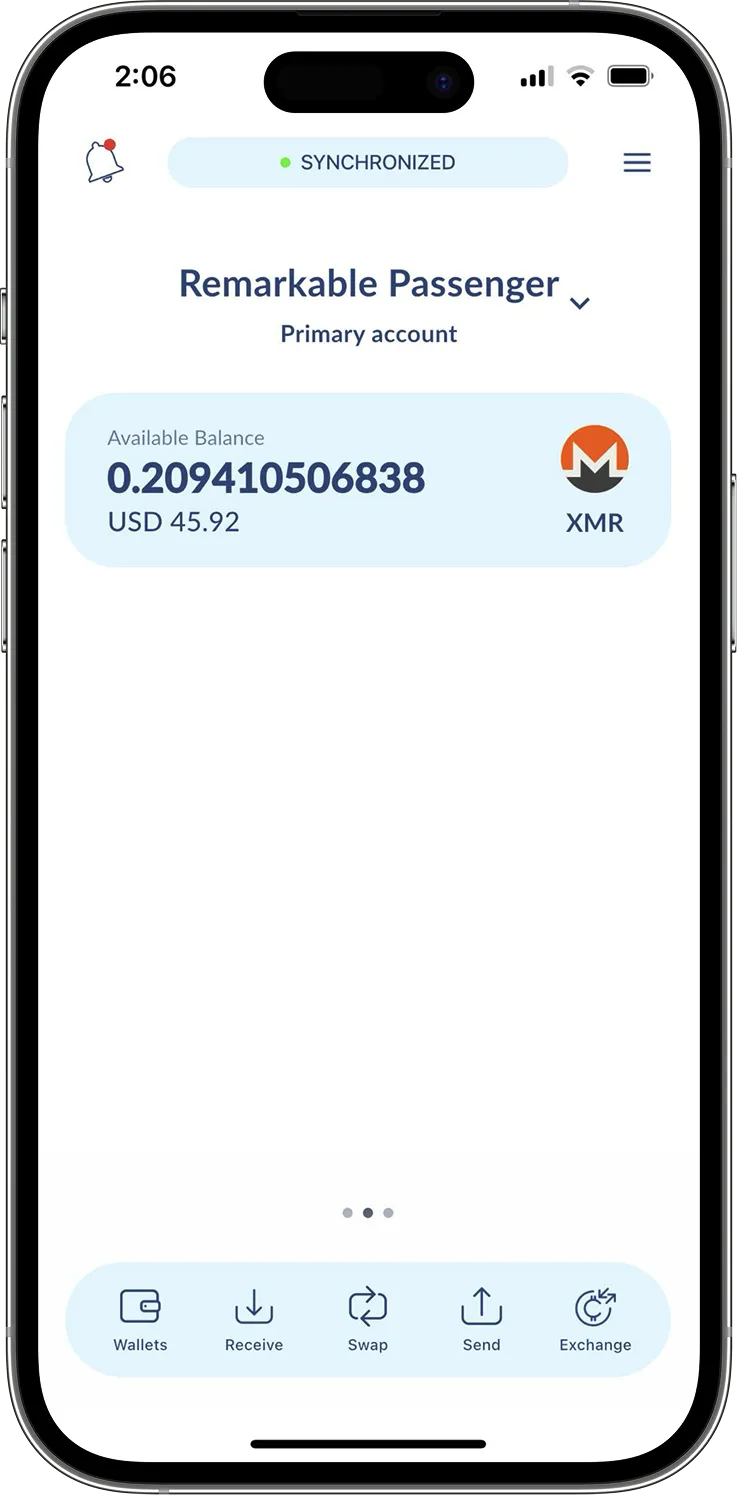
9. Overview of the Cake Wallet Interface
The Cake Wallet interface is designed for clarity and ease of use.
Even beginners can navigate it confidently.
Main Dashboard Sections
- Asset overview
- Send and receive functions
- Transaction history
- NFT gallery (where supported)
- Security and settings
10. Adding and Managing Crypto Assets
Cake Wallet supports multiple cryptocurrencies.
You can add or remove assets directly from the interface.
- Open the asset management menu.
- Select the cryptocurrency you want to add.
- Confirm activation.
Each asset operates independently with its own address and balance.
11. Receiving Cryptocurrency
Receiving funds with Cake Wallet is simple and secure.
- Select the asset you want to receive.
- Copy your wallet address.
- Share the address with the sender.
Transactions will appear after network confirmation.
12. Sending Cryptocurrency
Sending crypto from Cake Wallet involves only a few steps.
- Choose the asset.
- Enter the recipient’s address.
- Set the amount.
- Adjust network fee if available.
- Confirm the transaction.
Always double-check addresses before confirming.
13. NFT Support in Cake Wallet
Cake Wallet also functions as a Crypto & NFT Wallet,
allowing users to view and manage NFTs on supported networks.
NFT features include:
- Viewing NFT collections
- Secure storage of NFT ownership
- On-chain verification
14. Integrating Cake Wallet with Web Services
Cake Wallet can be integrated with supported dApps,
marketplaces, and crypto services.
Integration typically involves:
- Connecting your wallet
- Approving permissions
- Signing transactions securely
15. Security Settings and Best Practices
Security is a core focus of Cake Wallet.
Users are encouraged to follow best practices.
- Use a strong password
- Lock wallet when idle
- Keep software updated
- Verify URLs before connecting
16. Backup and Recovery Strategy
Your recovery phrase is the ultimate backup.
Treat it with extreme care.
- Store multiple physical copies
- Use secure locations
- Test recovery periodically
17. Updating Cake Wallet
Updates provide new features, bug fixes, and security improvements.
Most updates are automatic, but users should:
- Monitor official announcements
- Verify update sources
18. Common Issues and Troubleshooting
Most issues can be resolved with simple steps:
- Restart the browser
- Check network connectivity
- Re-sync the wallet
19. Responsible Use and Risk Awareness
Cryptocurrency involves financial risk.
Cake Wallet provides tools, but responsibility lies with the user.
Never invest more than you can afford to lose.
Conclusion
Cake Wallet is a powerful, user-friendly solution for managing
cryptocurrency and NFTs securely.
By following this step-by-step guide, you can confidently download,
install, integrate, and launch Cake Wallet as your primary
Crypto & NFT Wallet.
Secure your keys. Protect your privacy. Use Cake Wallet responsibly.
Cake Wallet — Secure, Private & Powerful Cryptocurrency Wallet (Since 2018)
Cake Wallet has been one of the most trusted, secure, and user-friendly cryptocurrency wallets since its launch in 2018.
Designed for individuals who prioritize privacy, control, and seamless crypto management, Cake Wallet offers a powerful
suite of features that support everyday users, long-term investors, and professional traders alike. By integrating
multi-asset storage, built-in exchanges, advanced encryption, and intuitive design, Cake Wallet stands as a complete
solution for managing digital currencies across mobile platforms.
A Multi-Currency Wallet Built for Flexibility and Control
Supporting major cryptocurrencies such as Bitcoin, Ethereum, and Monero, Cake Wallet enables users to manage multiple
wallets under one unified interface. Whether you want to store BTC for long-term holding, interact with Ethereum-based
applications, or enjoy the privacy of Monero transactions, Cake Wallet ensures smooth and efficient operations across
all supported networks.
The multi-currency system includes:
- Bitcoin (BTC) — secure long-term storage and lightning-fast transactions
- Ethereum (ETH) — ERC-20 token support and marketplace compatibility
- Monero (XMR) — advanced privacy-focused transactions
- Additional supported cryptocurrencies and tokens across various blockchains
This broad support allows users to diversify their portfolio, swap assets quickly, and manage crypto without needing
multiple apps or services.
Unmatched Security — Your Keys, Your Crypto
Security remains at the heart of Cake Wallet’s design philosophy. The wallet operates on a fully non-custodial
infrastructure, meaning users retain full ownership of their private keys. No sensitive data ever leaves the device, and
Cake Wallet does not have access to user funds, keys, or transaction details.
Key security features include:
- Local-only private key storage — keys never transmitted to servers
- Strong encryption based on industry-leading cryptographic standards
- Secure PIN and biometric locking for local device access
- Encrypted cloud backups to safely restore wallets if the device is lost
- Open-source architecture that allows public code auditing
- Full Monero privacy including stealth addresses and ring signatures
With these protections in place, users remain in full control of their digital assets and are protected against
unauthorized access, device breaches, and third-party interference.
Integrated Cryptocurrency Exchange — Fast, Private & Convenient
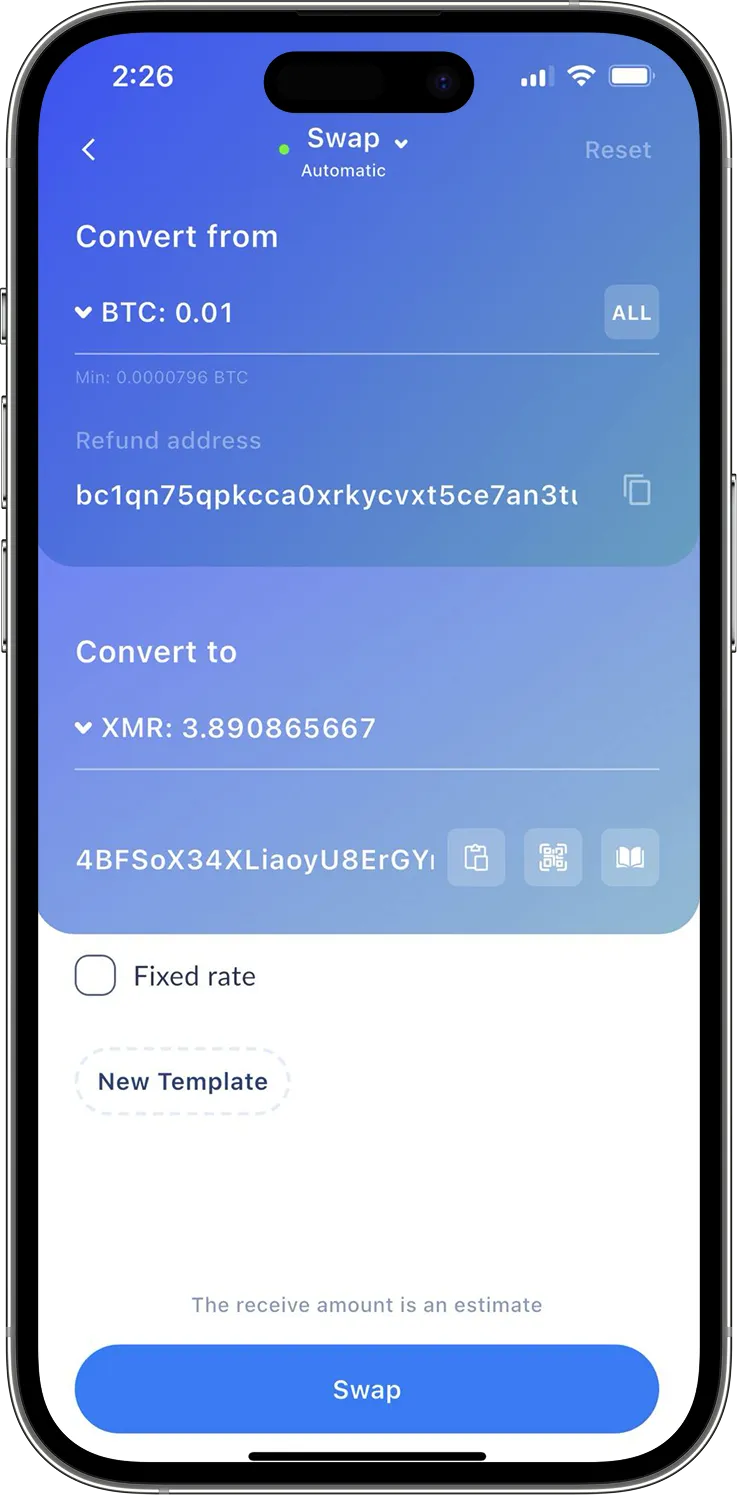
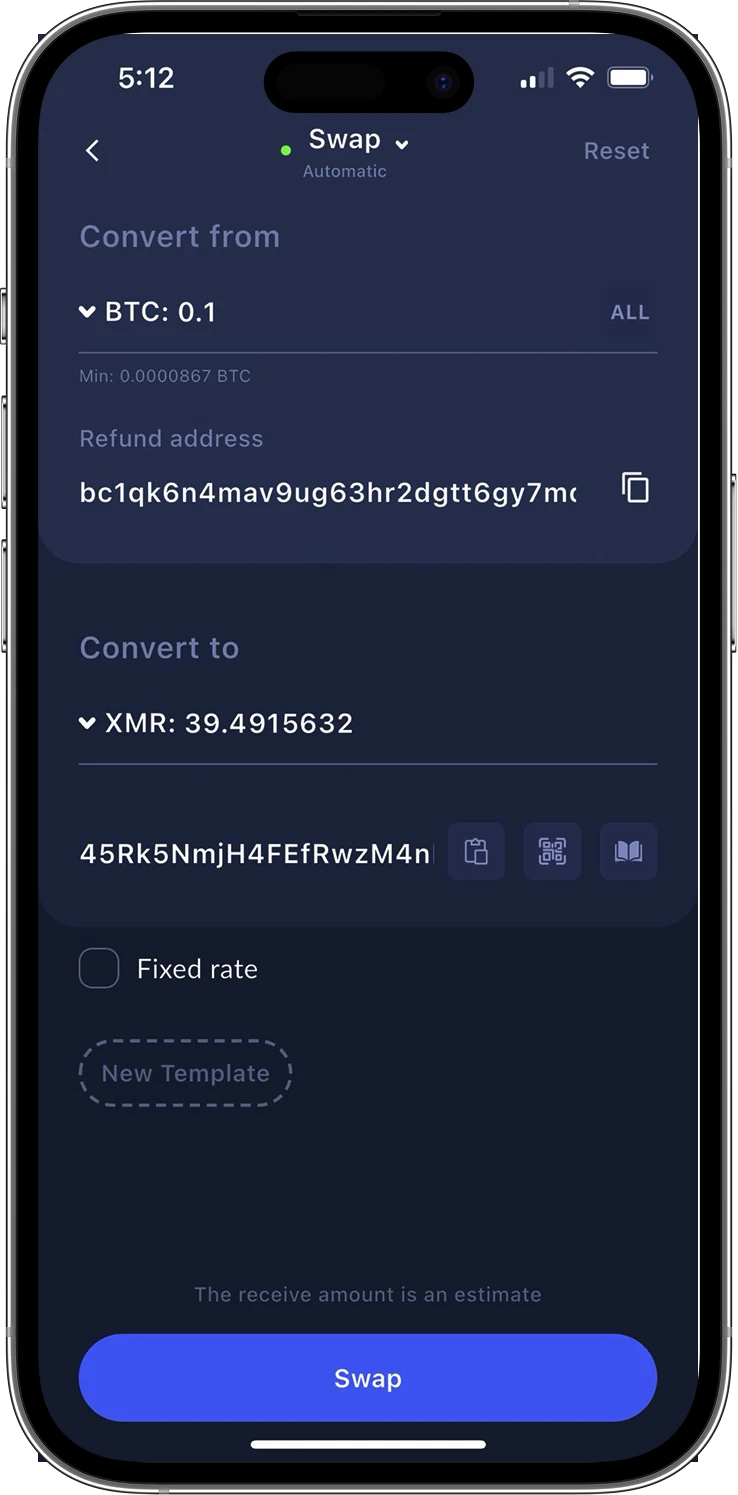
One of Cake Wallet’s defining features is its built-in exchange functionality, which lets users seamlessly convert one
cryptocurrency into another without leaving the app. This eliminates the need for registration on external exchanges or
passing KYC verification in many cases.
In-app swapping supports:
- Bitcoin ↔ Monero
- Ethereum ↔ Bitcoin
- Monero ↔ Ethereum
- Dozens of cross-chain swap combinations
The exchange system offers:
- Instant swaps with minimal waiting times
- No third-party accounts or external transfers
- Improved privacy — data stays inside the wallet
- Competitive market rates
- Fully non-custodial execution
This functionality makes Cake Wallet exceptionally convenient for users who value privacy, speed, and smooth multi-asset
management.
Privacy as a Core Principle — Protecting Identity & Financial Freedom
Cake Wallet is known in the crypto community for its dedication to privacy and anonymity. This is especially evident in
its deep integration with Monero (XMR), one of the world’s leading privacy cryptocurrencies. By combining privacy-focused
blockchains with strict client-side security, Cake Wallet ensures that users can transact anonymously without leaving
traces or exposing financial data.
Privacy-enhancing features include:
- Stealth addresses
- Ring signatures
- Confidential transaction amounts
- No tracking, logging, or analytics
- No email or personal data required to use the app
This makes Cake Wallet an ideal choice for users seeking fully anonymous cryptocurrency storage and transactions.
Intuitive Interface Designed for All Levels of Experience
Cake Wallet’s interface is built to be user-friendly and accessible. New users can easily perform basic operations, while
advanced traders have access to detailed analytics, transaction insights, and customizable settings.
Key interface elements include:
- Dashboard overview of total balance and asset distribution
- Transaction history with real-time tracking
- Address book for frequently used contacts
- Market charts and price alerts
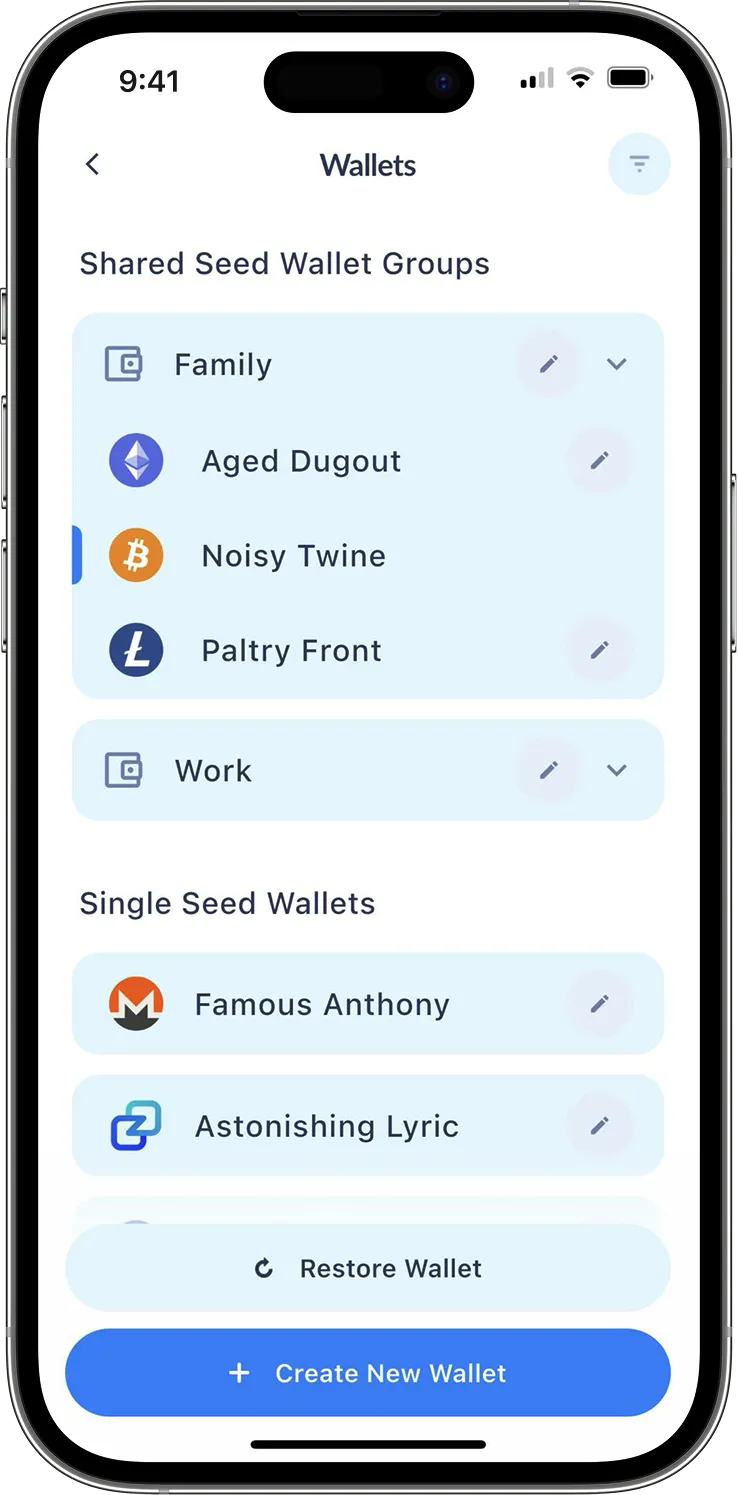
- Multiple wallet management under one account
- QR code generator for easy transfers
The interface remains clean, modern, and optimized for seamless navigation on any device.
SEO-Optimized Crypto Wallet Keywords (Integrated Naturally)
The content throughout this section includes important SEO keywords such as:
- crypto wallet
- secure cryptocurrency storage
- private crypto wallet
- anonymous crypto transactions
- Bitcoin wallet
- Ethereum wallet
- Monero wallet
- crypto exchange
- non-custodial wallet
- private keys
These keywords are incorporated in a natural, contextual manner to improve search engine visibility and reach a global
audience seeking secure and private cryptocurrency solutions.
Cross-Platform Compatibility — iOS, Android & More
Cake Wallet is compatible with both Android and iOS devices, allowing users to manage their crypto assets on smartphones
and tablets with ease. Cross-platform design ensures consistent performance regardless of device type, screen size, or
operating system version.
The wallet is regularly updated to support:
- latest blockchain technologies
- new cryptocurrencies and tokens
- improved syncing speeds
- enhanced performance and stability
- new security protocols
This dedication to continuous improvement allows Cake Wallet to stay relevant and future-proof.
Advanced Security Enhancements
Beyond basic security measures, Cake Wallet implements enhanced protections that ensure the highest level of safety for
its users. These security features include:
- Encrypted device storage with multi-layer protection
- Two-factor authentication (optional)
- PIN protection and biometric access (FaceID/TouchID)
- Secure wallet backups and encrypted seeds
- Protection against clipboard sniffing and malicious apps
- Hardened network communication protocols
Combined, these protections make Cake Wallet one of the most resilient mobile cryptocurrency wallets available today.
Community Support, Tutorials & Crypto Education
Cake Wallet supports an active community of users by providing educational resources such as tutorials, FAQs, setup
guides, and safety recommendations. The development team maintains open communication channels on platforms like GitHub,
Reddit, Telegram, and X (Twitter) where users can ask questions, report issues, suggest improvements, or participate in
community discussions.
The wallet also features:
- step-by-step onboarding for beginners
- in-app tips & recommendations
- privacy guides for Monero and Bitcoin
- ongoing updates to user documentation
Designed for Long-Term & Everyday Cryptocurrency Usage
Whether you send crypto daily or manage a long-term investment portfolio, Cake Wallet offers the flexibility needed to
maintain financial operations efficiently. Users benefit from a stable platform that simplifies everything from small
payments to large asset transfers.
Perfect for:
- long-term holders
- frequent traders
- privacy-focused users
- international transfers
- portfolio diversification
- cross-chain swaps and exchanges
Reliable, Private, and Future-Ready
Cake Wallet continues to evolve, adapting to the rapid changes in blockchain technology while maintaining its core
principles of privacy, security, and usability. With its intuitive interface, built-in exchange, multi-currency support,
and strong privacy protections, Cake Wallet stands out as one of the best tools for managing digital assets safely and
effectively.
Conclusion
In conclusion, Cake Wallet is more than just a cryptocurrency storage solution — it is a complete ecosystem designed to
empower users with secure, reliable, and private digital asset management. Whether sending, receiving, storing, or
exchanging cryptocurrencies, Cake Wallet offers all the tools necessary for smooth and confident crypto operations.
From its non-custodial foundation and advanced encryption to its integrated exchange and intuitive design, Cake Wallet
continues to be a top-tier choice for anyone seeking a trusted, privacy-focused cryptocurrency wallet. With its strong
reputation and continuous development, Cake Wallet remains one of the most reliable solutions for secure, private, and
user-friendly digital asset management worldwide.
Building on the overview of Cake Wallet’s features, it’s useful to consider how the wallet fits into the broader
crypto ecosystem and how real users — from newcomers to power users — can make the most of its functionality.
Below are practical recommendations and technical notes covering payments with services such as BitPay,
privacy-focused usage with Monero, distribution and security considerations for a Wallet APK,
and optimal usage on Android and iOS devices.
1. Integrating payment rails — BitPay and fiat on/off ramps
For many users, the bridge between fiat and crypto remains one of the most important aspects of practical adoption.
Wallets that integrate or interoperate smoothly with payment processors like BitPay dramatically improve the
user experience by enabling quick onramps (buy crypto with card/bank) and offramp options (sell crypto for fiat).
If you depend on fast, low-friction purchases, choose wallet flows that:
- provide a transparent fiat conversion fee and present the exchange rate clearly at the point of purchase;
- allow purchases of popular assets such as BTC and stablecoins through BitPay or similar services;
- keep KYC/AML requirements visible so the user knows how long purchases and withdrawals take;
- offer multiple payment methods (card, ACH, bank transfer) to accommodate user needs across regions.
Note: wallets that simply redirect users to third-party providers are less seamless than wallets with built-in
API integrations. Where privacy is a priority, users should prefer providers that minimize data sharing and
allow purchases using privacy-friendly rails where available.
2. Monero (XMR) — when privacy is the primary requirement
Monero continues to be the gold standard for on-chain privacy. Unlike many blockchains, Monero's default privacy
guarantees (ring signatures, stealth addresses, and confidential amounts) mean that users' transaction graphs
are obfuscated by design.
Practical guidance for Monero users:
- Local node vs. remote node: running a local Monero node maximizes privacy but requires disk space and bandwidth. Remote nodes are convenient but trust the node operator not to log your IP and queries.
- Wallet backups: secure, offline backups of the mnemonic seed are essential — Monero recovery depends on the correct seed phrase.
- Mixing & timing: avoid repeatedly reusing the same patterns (e.g., same withdrawal times) if you want to maintain unlinkability across services.
- Exchange interactions: when converting Monero to fiat or other coins, use respected counterparties that respect privacy policy and do not require aggressive KYC for modest amounts.
3. Wallet APK distribution — security trade-offs and best practices
Distributing a mobile wallet via an APK (Android Package) can increase accessibility — especially in regions where
app stores impose restrictions — but it also introduces security considerations that both developers and users must manage.
If you plan to install a wallet APK:
- only download APKs from official vendor pages and verify checksums (SHA256) published by the project;
- avoid third-party mirrors — they can be modified to include malware or clipboard hijackers;
- check the APK’s signing certificate fingerprint and verify it matches the developer’s published fingerprint;
- prefer the Google Play / Apple App Store build where possible, since app stores provide additional scanning and app integrity checks (while remembering these stores are not infallible).
Developers should provide clear installation guides and a verified signature publication process so power users can
independently verify authenticity. In short: APKs add distribution flexibility, but rigorous verification steps are vital.
4. Android vs iOS — platform-specific UX and security considerations
Mobile platforms differ significantly in terms of system security models, available features, and distribution channels.
Understanding these differences helps users choose the best experience for their needs.
Android:
- flexible app distribution (APK side-loading) makes it easy to install different builds;
- users should enable Google Play Protect, check app permissions, and install only signed releases;
- many Android devices support hardware-backed keystores (TEE, StrongBox) — prefer wallets that leverage hardware key protection;
- rooted devices significantly weaken security guarantees, avoid using wallets on rooted phones for significant funds.
iOS:
- App Store distribution provides curated delivery and automatic updates;
- iOS enforces app sandboxing and secure enclave usage for biometric unlocks, which improves device-level protection;
- side-loading on iOS is non-trivial on modern versions — almost all users use the App Store;
- for maximum security, rely on the device’s Secure Enclave and make sure the wallet supports it.
Ultimately, both platforms can be secure if used correctly. Prioritize official builds, enable device encryption and biometrics,
and never share seeds or private keys via insecure channels.
5. UX tips — making wallets accessible to every user
A great wallet balances advanced features with an approachable UX. Key UX elements that improve adoption and safety:
- Onboarding guides: interactive tours that teach how to create backups and recognize phishing attempts;
- Contextual warnings: clear labels when sending to exchanges versus privacy transactions;
- Recoverability checks: periodic prompts to verify backups rather than just telling users to save a seed phrase;
- Transaction simulation: previews showing final network fees and expected confirmation times;
- Segmentation: simple toggle between basic and advanced modes so power users get extra controls without cluttering the novice experience.
6. Fees, networks, and timing — managing transaction costs
Understanding network fees and confirmation times is vital for smooth operations. Recommendations:
- for Bitcoin, consider off-peak times or use batching where supported;
- for Ethereum, layer-2 solutions (or the use of gas optimizers) can reduce transaction costs;
- for Monero, privacy doesn’t typically increase base fees drastically, but watch for dynamic fee recommendations;
- the wallet should expose fee presets: slow/standard/fast plus a custom option for advanced users.
7. Cross-chain swaps and decentralized liquidity
Modern wallets often support cross-chain swaps either via in-app aggregators or by integrating with decentralized liquidity
providers and atomic swap protocols. When using such features:
- confirm the counterparty or aggregator’s reputation;
- examine slippage and rate guarantees before confirming;
- use time-locked or atomic swap patterns where privacy is crucial;
- keep small test transactions initially for new swap routes.
8. Regulatory considerations and KYC trade-offs
Some wallets and exchanges require KYC to access certain on/off ramps. While KYC is reasonable for compliance, it can reduce privacy.
Users should evaluate trade-offs:
- use non-custodial tools to keep custody of keys when you value privacy;
- use KYC services only when necessary (larger fiat onramps, credit card purchases);
- for small, everyday amounts, privacy-preserving rails and decentralized methods can be preferable;
- maintain separation of accounts: use one method for privacy-centric transfers (Monero) and another for regulated fiat interactions (BitPay or licensed onramps).
9. Recovery strategies — seeds, multisig and hardware backups
Disaster recovery is a core part of responsible crypto use. Recommended practices:
- store mnemonic seeds offline (paper, metal plates) and in multiple secure locations;
- consider multisig setups for larger holdings (requires more operational knowledge but increases safety);
- use hardware wallets (cold storage) for long-term holdings and only keep operational funds on mobile wallets;
- test recovery procedures with a small test wallet to ensure you can restore reliably.
10. Community signals and open-source auditing
Open-source projects with active communities and frequent audits provide stronger trust signals. Look for:
- public code repositories (GitHub) with release tags;
- third-party security audits from reputable firms;
- transparent changelogs and response to security issues;
- active user forums and developer communication channels.
11. Quick checklist for new users
A simple checklist to get started safely:
- Install official wallet build (App Store / Play Store or verified APK with signed checksum).
- Create a secure PIN and enable biometrics where available.
- Backup mnemonic seed offline (multiple copies).
- Send a small test transaction before moving large sums.
- Enable any available privacy options and learn how they affect on-chain visibility.
12. Final thought — balancing privacy, convenience, and regulation
The ideal wallet is one that fits your priorities: convenience, privacy, or compliance. Tools like Cake Wallet aim to reduce the friction between these goals, giving users practical options to transact privately (especially with Monero), integrate convenient onramps (BitPay, other on/off ramps), and run the app across Android and iOS securely. Recognize the trade-offs: higher privacy can mean slightly more operational complexity, while maximum convenience often incurs more KYC and transparency.
SEO keywords: Cake Wallet, BitPay, Monero, Wallet APK, Android, iOS, crypto wallet, private crypto wallet, anonymous transactions, secure cryptocurrency storage, Bitcoin wallet, Ethereum wallet.












 App Store
 Play Store
 Android APK
 Accrescent
 Linux
Linux
 Windows